
Cybersecurity Risk Management Guide: How to Protect Your Business by Prioritizing What Matters Most
Cybersecurity risk management isn't about eliminating every risk. It's about understanding which risks matter most, prioritizing them effectively, and building a practical plan to reduce them before they impact your business.
Two organizations can experience the same cyber attack and face completely different outcomes.
One identifies the threat quickly, contains it before it spreads, and resumes operations with minimal disruption. The other spends days recovering systems, notifying customers, and dealing with financial losses, regulatory scrutiny, and reputational damage.
According to a report, organizations fully remediated only 26% of CISA's known exploited vulnerabilities during 2025. The challenge isn't simply identifying cyber risks; it's knowing which ones to address first and having a process to manage them consistently. That's exactly what cybersecurity risk management is designed to do.
Rather than trying to protect everything equally, cybersecurity risk management helps organizations understand where they're most vulnerable, evaluate the potential business impact of those risks, and decide how best to address them. Some risks require immediate action. Others need continuous monitoring, additional safeguards, or simply a documented decision to accept them based on business priorities.
At ER Tech Pros, we've seen organizations invest heavily in security tools yet still struggle to answer simple questions like "Which risks matter most?" Where should we invest first? Are we actually reducing risk or just adding more technology?
Those are the questions this guide answers.
Whether you're building your first formal risk program or strengthening an existing one, understanding how to evaluate and prioritize cyber risk is the foundation of a stronger security strategy.
Ready to Strengthen Your Cybersecurity Posture?
Security Isn't About Eliminating Every Risk
When people think about cybersecurity, they often picture firewalls, antivirus software, endpoint protection, or multi-factor authentication. Those technologies are important, but on their own, they don't tell you where your greatest risks are or which investments will have the biggest impact.
That's the difference between security controls and risk management in cybersecurity.
Security controls are the tools and processes you use to defend your environment. Cybersecurity risk management is the decision-making process behind those controls. It helps organizations determine which assets need the most protection, which vulnerabilities pose the greatest business risk, and how to allocate limited time and budgets.
In other words, it's about making informed business decisions.
Organizations that approach security this way spend less time reacting to headlines and more time addressing the risks that could genuinely disrupt operations.
So, what is cybersecurity risk management in practical terms?
It's a continuous process of identifying assets, assessing threats and vulnerabilities, understanding potential business impact, and deciding whether each risk should be reduced, monitored, transferred, or accepted. Because technology, users, and threats are constantly changing, it's a process that evolves alongside the business, not a project that's completed once and forgotten.
Why Cyber Risk Is Becoming Harder to Manage?
Not long ago, most business systems lived inside an office network protected by a firewall.
Today, employees work remotely, applications run in the cloud, and third-party vendors often have access to critical business systems. Every new application, connected device, or cloud service expands the organization's digital footprint, and with it, the number of opportunities for attackers.
At the same time, cybercriminals have become faster and more organized. AI-powered attacks, ransomware-as-a-service, credential theft, and increasingly convincing social engineering campaigns have significantly changed the threat landscape. These growing cybersecurity challenges make it unrealistic for organizations to treat every vulnerability with the same level of urgency.
That's why one of the most important cybersecurity trends in 2026 isn't buying more security tools; it's learning how to prioritize risk more effectively.
Organizations that understand which vulnerabilities pose the greatest business impact recover faster, allocate budgets more efficiently, and make better security decisions than those trying to fix everything at once.
A Good Framework Helps You Make Better Decisions
Without structure, risk management quickly becomes reactive.
A critical vulnerability gets patched because it appears in the news. Another project gets delayed because a compliance audit is approaching. Security priorities shift based on whichever issue feels most urgent that week.
A cybersecurity risk management framework provides consistency.
Rather than responding to each new threat individually, it provides organizations with a repeatable process for identifying risks, evaluating their impact, deciding how to address them, and reviewing those decisions over time.
Many organizations use frameworks because they provide a proven methodology for making security decisions. The framework itself doesn't prevent attacks. Instead, it ensures that security investments are based on business priorities rather than assumptions.
Regardless of which framework an organization adopts, the process typically follows four essential stages.
Know What You're Protecting
Before you can reduce cyber risk, you need visibility into your environment.
That means identifying critical business systems, sensitive information, cloud services, employee devices, privileged accounts, business applications, and third-party connections.
Many organizations are surprised by what they discover during this stage. Forgotten servers, unused administrator accounts, outdated applications, or unauthorized cloud services often remain active long after they've been abandoned, quietly increasing the organization's exposure.
A complete inventory creates the foundation for every decision that follows.
Evaluate Risks Based on Business Impact
Not every vulnerability deserves immediate attention.
A low-risk software flaw affecting an internal application shouldn't receive the same priority as a vulnerability exposing sensitive customer information.
This is where many organizations struggle. Security teams often focus on fixing the largest number of vulnerabilities rather than addressing those that pose the greatest business risk.
An effective assessment considers questions such as:
- How likely is this risk to be exploited?
- Which systems or data could be affected?
- What would downtime cost the business?
- Could it create regulatory or legal consequences?
- How would it impact customers or business operations?
Looking at risk through a business lens helps organizations prioritize resources more effectively, rather than trying to solve every issue simultaneously.
Decide How Each Risk Should Be Managed
Finding a risk doesn't automatically mean eliminating it.
In fact, one of the biggest misconceptions about cybersecurity is that every identified vulnerability must be fixed immediately.
A mature organization understands that every decision involves trade-offs.
Some risks should be addressed immediately through technical controls or process improvements.
Others may require additional monitoring until a permanent solution becomes available.
Certain risks can be transferred through contractual agreements or cyber insurance, while others may be accepted because the cost of remediation outweighs the potential business impact.
This concept, often referred to as risk appetite, is central to good cybersecurity decision-making. Organizations with a clearly defined risk appetite can prioritize investments confidently because they understand which risks are acceptable and which require immediate action.
Keep Reviewing as Your Business Changes
Risk management isn't something you complete and check off a list.
Every new employee, software platform, vendor relationship, cloud migration, or business acquisition changes your organization's risk profile.
That's why cybersecurity risk management works best as an ongoing cycle rather than an annual exercise.
Regular vulnerability assessments, continuous monitoring, and scheduled reviews ensure that security decisions remain aligned with evolving business operations and emerging threats.
They also give leadership greater confidence that investments are reducing meaningful business risk.
Choosing Solutions That Reduce Business Risk
Once a framework and strategy are in place, the next question is simple: What do we need to put this into practice?
This is where many organizations make an expensive mistake. They invest in the latest security platform without first understanding the problem they're trying to solve. The result is often a collection of tools that generate thousands of alerts but offer little clarity on which risks warrant immediate attention.
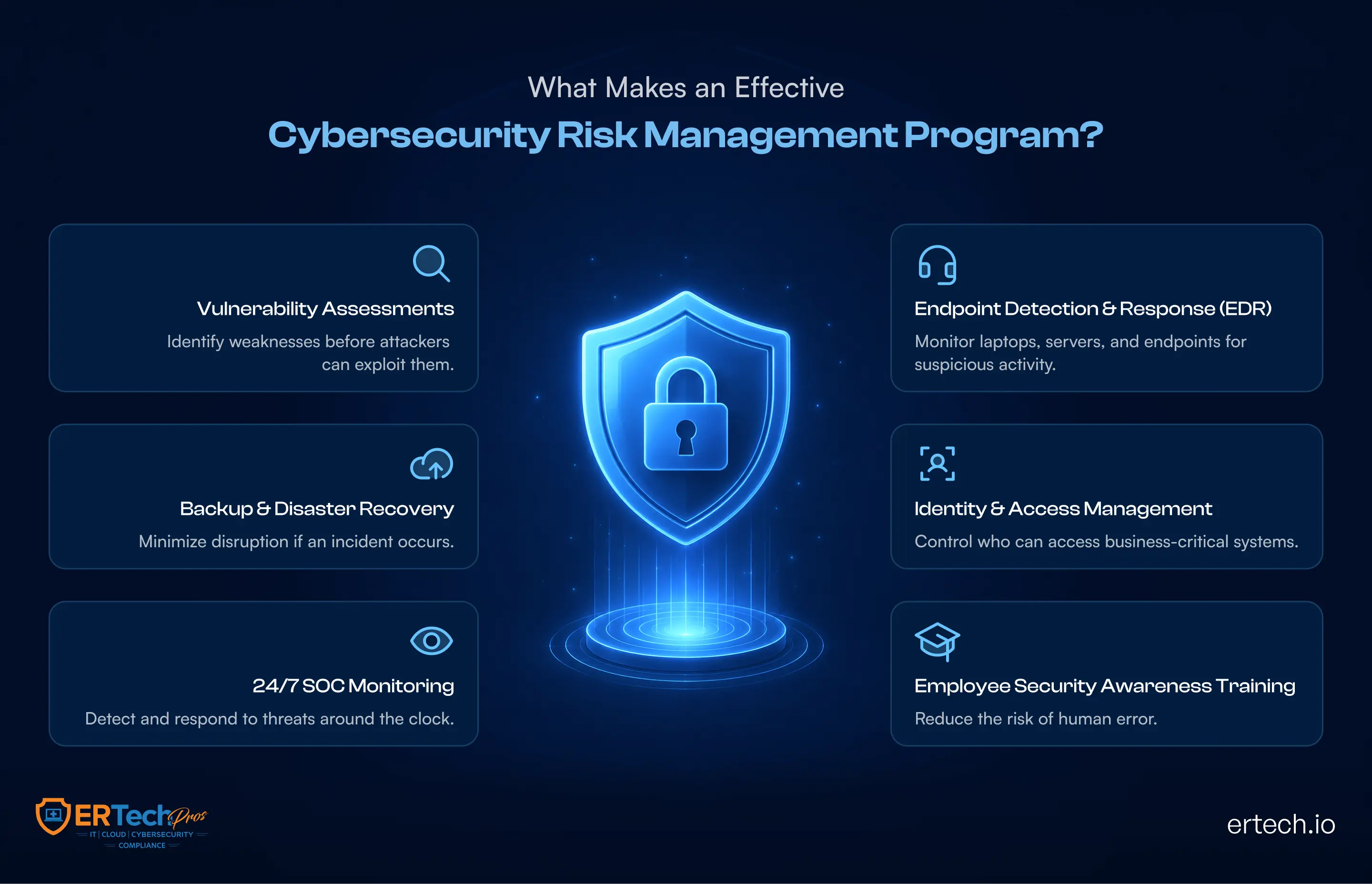
The best cybersecurity risk management solutions help organizations make better decisions. They provide visibility into vulnerabilities, monitor suspicious activity, prioritize risks based on business impact, and support faster response when incidents occur.
Don't Forget Your Third-Party Vendors
Your cybersecurity program extends beyond your own network. Cloud providers, software vendors, consultants, and managed service providers can all introduce risk if they have access to your systems or data.
That's why cybersecurity vendor risk management is an essential part of any security program. Before granting access, organizations should evaluate a vendor's security practices, review permissions regularly, and verify that they meet industry standards, such as SOC 2 compliance, where applicable.
Simply put, if a third party can access your environment, their security becomes part of yours.
People Still Play the Biggest Role in Cybersecurity
Even the strongest technical controls can't eliminate human error.
Employees approve invoices, open email attachments, access cloud applications, and make hundreds of security-related decisions every day. A single mistake can create an opportunity for attackers.
That's why cybersecurity awareness should be viewed as an essential part of risk management, not an annual compliance exercise.
Organizations that invest in ongoing education help employees recognize suspicious requests, verify unexpected payment instructions, and identify increasingly sophisticated phishing email attacks before they become security incidents.
Sharing practical email security tips, running phishing simulations, and creating a culture where employees feel comfortable reporting suspicious activity all contribute to reducing organizational risk.
When employees understand their role in protecting the business, they become an additional layer of defense rather than another point of vulnerability.
How ER Tech Pros Helps Organizations Build Stronger Security Programs
Understanding cyber risk is one thing. Managing it consistently across your entire organization is another.
Many businesses know they need better visibility into their security posture but don't have the internal resources to continuously assess risks, monitor threats, investigate alerts, and keep pace with an evolving threat landscape. Others have invested in multiple security tools but still struggle to determine whether those investments are reducing meaningful business risk.
That's where ER Tech Pros makes the difference.
For more than 27 years, we've helped organizations build practical cybersecurity programs that focus on reducing risk. Our approach combines experienced security professionals, continuous monitoring, and proven security processes to help businesses stay ahead of emerging threats while supporting day-to-day operations.
Our cybersecurity services include:
- 24/7 Security Operations Center (SOC) monitoring to detect and respond to threats before they disrupt your business.
- Managed Detection and Response (MDR) powered by advanced threat intelligence and AI-driven analytics for faster threat identification.
- Vulnerability assessments and risk analysis that identify security gaps and prioritize remediation based on business impact.
- Endpoint security management to protect workstations, servers, and remote devices.
- Security awareness training that helps employees recognize social engineering attempts and strengthen everyday security habits.
- Incident response planning and testing so your organization knows exactly how to respond to security events.
- Compliance support for organizations operating in regulated industries, including healthcare settings subject to HIPAA requirements.
- Strategic guidance that transforms risk assessments into an actionable security roadmap aligned with your business objectives.
Whether you're strengthening an existing security program or building one from the ground up, our team helps you move beyond reacting to cyber incidents and toward proactively managing cyber risk every day.
Good Risk Management Never Stops
Every new application, employee, cloud service, vendor relationship, or business initiative changes your organization's risk profile. The organizations that remain resilient are those that continuously evaluate risk, make informed decisions, and adapt as their businesses evolve.
That's what effective cybersecurity risk management is really about.
It's a continuous process of understanding where your business is exposed, prioritizing what matters most, and making thoughtful decisions that strengthen resilience over time. The organizations that embrace this approach are better prepared to respond to new threats, recover faster from incidents, and make smarter security investments.
If you're looking for the right cybersecurity partner to strengthen your security program, or you're evaluating how to choose a managed service provider that takes a proactive approach to cybersecurity, ER Tech Pros is here to help.
Our team works alongside organizations to identify risks, improve visibility, strengthen defenses, and build security programs that support long-term business growth.
Build a Cybersecurity Risk Management Program That Works
Discover how a proactive approach to cybersecurity risk management can help protect your business, reduce operational risk, and build lasting resilience.
Got Questions?
We've Got Answers
Find clear answers to common questions that help guide your healthcare IT operations.
Healthcare IT Solutions Built for Every Critical Second
How Managed IT Services Support Educational Institutions
Cybersecurity Best Practices for Organizations in 2026: A Practical Guide