Cybersecurity Best Practices for Organizations in 2026: A Practical Guide
Most breaches don't start with a sophisticated exploit; they start with a missed basic. This guide breaks down the cybersecurity best practices every organization should have in place and how to put them into practice.
Most organizations don’t get breached because of a brilliant, unstoppable attacker. They get breached because of a missed software update, a reused password, or an employee who clicks the wrong link. According to the 2026 Data Breach Investigations Report, 31% of breaches begin with vulnerability exploitation, making unpatched systems a leading entry point for attackers.
As cyber threats become more advanced, attackers are also finding new ways to exploit familiar weaknesses. Unpatched systems, compromised credentials, and insufficient security awareness continue to create opportunities for breaches.
That's the real reason cybersecurity best practices matter more than any single piece of software. Tools change. Vendors change. But the fundamentals- how you manage identity and access, how you train people, how you patch systems, and how you respond when something goes wrong- are what actually determine whether your organization is resilient or vulnerable.
At ER Tech Pros, we work with businesses every day that have invested in security tools but never built the underlying practices that make those tools effective. This guide outlines the best cybersecurity practices that every organization, regardless of size, should have in place.
Don't Wait for a Breach to Find the Gaps
Why Cybersecurity Best Practices Matter More Than Ever in 2026?
The cybersecurity challenges organizations face today are compounding faster than most internal IT teams can track on their own. Attackers are using AI to write more convincing phishing emails, automate reconnaissance, and identify weak points faster than manual defenses can respond. At the same time, businesses are running more of their operations through cloud platforms, remote endpoints, and third-party software integrations, which expands the number of places something can go wrong.
Keeping pace with shifting cybersecurity trends matters, but chasing every new tool won't keep organizations safe. Analysis of the biggest data breaches in recent years consistently traces back to the same root causes. This is why cybersecurity best practices 2026 look less like a list of new tools and more like a renewed focus on fundamentals, executed with more discipline and less tolerance for gaps than in previous years.
Core Technical Controls Every Organization Needs in Place
Before looking at best practices by role or organization, it helps to establish the baseline. These controls form the foundation on which every organization should stand, regardless of industry or headcount.
Identity and Access Management
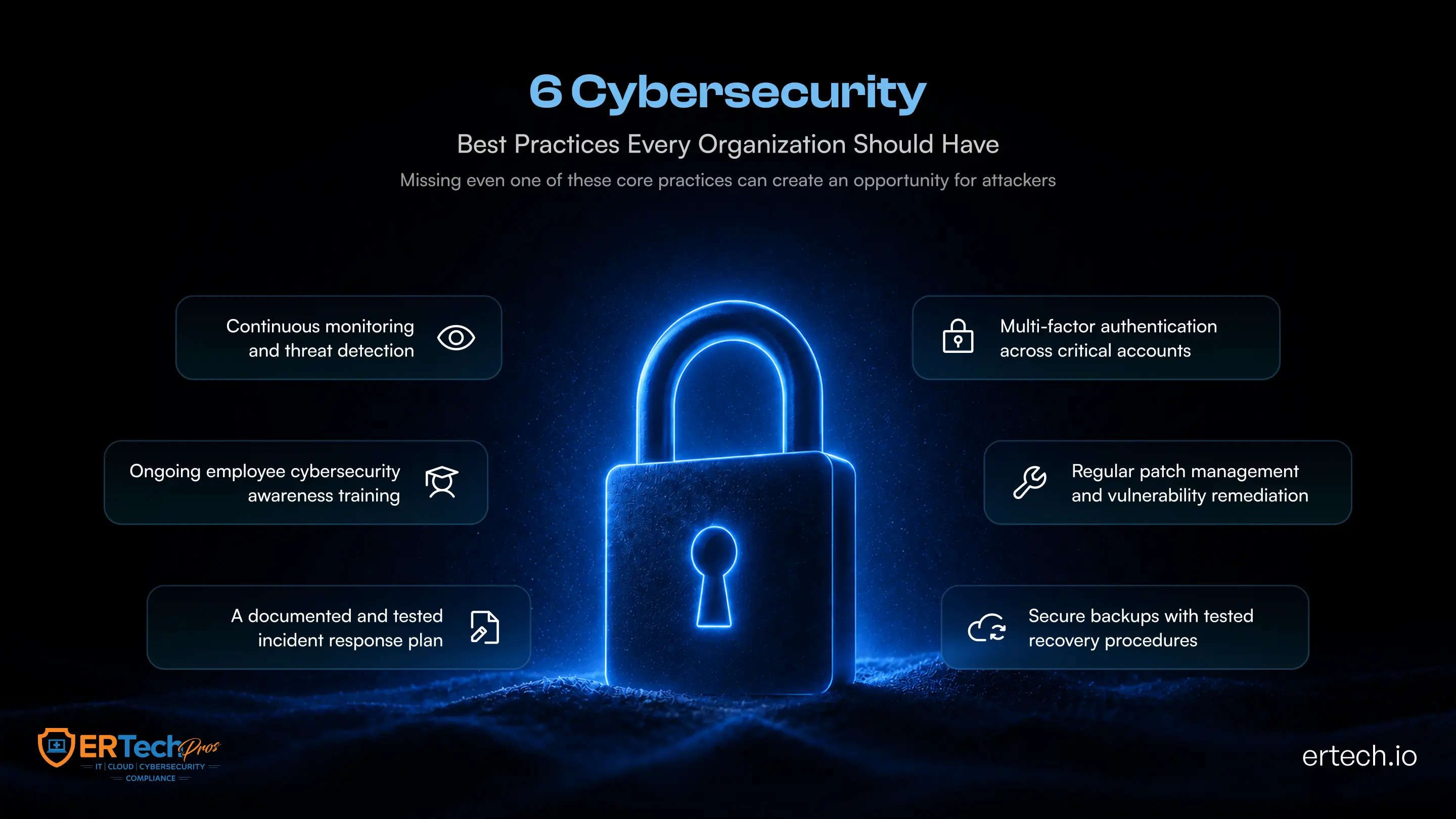
Every account in your environment is a potential entry point. Enforcing multi-factor authentication (MFA), applying role-based access control (RBAC) so users only hold the permissions their job requires, and using privileged access management (PAM) for administrative accounts closes off the easiest paths attackers rely on. Access should also be reviewed periodically and revoked immediately when someone changes roles or leaves the organization, since stale credentials are a common and overlooked source of exposure.
Patch Management and Vulnerability Remediation
Unpatched software remains one of the most preventable causes of compromise, yet it's still one of the most common. A structured patch management cadence, covering operating systems, applications, firmware, and internet-facing infrastructure, closes known vulnerabilities before they can be exploited. This should be paired with periodic vulnerability scanning to catch misconfigurations and unpatched assets that fall outside routine update cycles.
Data Backup, Encryption, and Disaster Recovery
A tested backup strategy, following a structure like the 3-2-1 rule (three copies of data, on two different media types, with one stored off-site or air-gapped), is one of the most effective forms of data breach prevention available, particularly against ransomware. Backups should be encrypted both at rest and in transit, isolated from the primary network, and tested on a regular schedule to confirm they actually restore correctly when needed.
Continuous Monitoring and Detection
Threats rarely announce themselves. Endpoint detection and response (EDR) combined with continuous network monitoring allows anomalous behavior, an unexpected login location, unusual data transfer volume, or a privilege escalation attempt to be flagged and investigated before it escalates into a full incident.
Cybersecurity Best Practices for Employees: Closing the Human Risk Gap
Technology can only do so much if the people using it aren't equipped to recognize risk. Cybersecurity best practices for employees focus on building habits that hold up under pressure, not just policies that sit in a handbook no one reads.
Recognizing Social Engineering and Credential-Based Attacks
Phishing email attacks remain one of the most common initial access vectors into corporate networks, and AI-generated lures have made them harder to spot through grammar or formatting alone. Employees should be trained to verify unusual or urgent requests, especially anything involving credentials, payment changes, or sensitive data, through a separate communication channel before acting.
Maintaining Password and Device Hygiene
Using unique, complex passwords managed through a password manager, locking devices when unattended, and avoiding unsecured public Wi-Fi for sensitive work are low-effort habits that meaningfully reduce risk exposure without requiring technical expertise.
Reporting Incidents Without Hesitation
A culture where employees feel comfortable reporting a suspicious email or a mistaken click, without fear of blame, often catches incidents earlier than any technical control can. The faster a potential compromise is reported, the smaller the window an attacker has for lateral movement or data exfiltration.
Cybersecurity Best Practices for Organizations of Every Size
The principles behind strong cybersecurity stay consistent across organization size, but how they're implemented shifts significantly as a business grows. What changes isn't the goal; it's the complexity of the environment being protected and the formality of the processes needed to manage it.
Prioritizing Controls With Limited Security Resources
Cybersecurity best practices for small businesses should focus on the baseline controls outlined above, applied in order of impact rather than all at once. A basic inventory of where sensitive data lives and who has access to it makes that prioritization far more practical than trying to defend everything equally from day one.
Budget is almost always the limiting factor, making it important to understand cybersecurity costs and ROI early on. The cost of a tested incident response plan and baseline controls is consistently small relative to the cost of recovering from an unmanaged breach, including downtime, regulatory exposure, and reputational damage.
Formalizing Incident Response and Governance
As organizations grow, ad hoc responses become less viable. A documented incident response plan defines who is notified, what gets isolated, and how internal and external communication flows in the first hours after a suspected data breach. This plan should be assigned to specific roles and tested through periodic tabletop exercises, not left as a static document that's never been rehearsed.
Managing Vendor and Third-Party Exposure
Every vendor with access to your systems or data extends your attack surface. Reviewing vendor security postures before onboarding, using standardized assessment questionnaires, limiting third-party access to the least privilege, and periodically reassessing that access to prevent a weaker external partner from becoming an internal incident.
Meeting Formal Compliance Standards
For organizations handling healthcare, financial, or regulated customer data, working toward a recognized framework such as SOC 2 compliance provides structure to the security program and offers independent validation to clients and partners, rather than relying on self-reported assurances alone.
Reviewing the Program on a Defined Cycle
Controls that were sufficient two years ago may already have gaps today. A formal review at least annually, paired with continuous monitoring in between, keeps the program aligned with how both the organization and the threat landscape have actually changed.
How ER Tech Pros Helps Organizations Put Best Practices Into Action
Knowing what cybersecurity best practices look like on paper is one thing. Implementing them consistently, across every device, employee, and system, is where most organizations struggle. That gap is exactly where ER Tech Pros focuses its work.
Our team provides 24/7 monitoring through a dedicated Security Operations Center, so threats are caught and addressed round the clock rather than only during business hours. We layer in AI-powered threat detection to keep pace with increasingly automated attack methods and build compliance-aligned programs, including HIPAA-ready infrastructure management, so security and regulatory obligations advance together.
ER Tech Pros help close the human gap with structured employee cybersecurity awareness training, support vendor risk assessments to extend protection beyond internal systems, and build incident response plans that are actually tested, not just written and filed away. For organizations further along in their maturity, we help develop a full cybersecurity strategy roadmap that sequences these practices into a realistic, ongoing program.
Build Cyber Resilience Through Everyday Security Practices
It's worth being direct about what good security actually requires: not a single purchase, but sustained discipline. The organizations that hold up best when something goes wrong are the ones that treat these practices as part of how they operate, not as a one-off project set aside. That mindset, more than any individual tool, determines whether your organization gets through an incident with minor disruption or a major one.
Finding the right cybersecurity partner is often what makes that discipline sustainable, especially for organizations without the resources to build and maintain it entirely in-house. At ER Tech Pros, we help organizations build that consistency every day, through monitoring, training, planning, and support designed to fit how each business actually operates.
Strengthen Your Business Against Today's Cyber Threats
Whether you're improving existing security controls or building a cybersecurity program from the ground up, ER Tech Pros provides the expertise and ongoing support to help you stay protected.
Got Questions?
We've Got Answers
Find clear answers to common questions that help guide your IT operations.
Related Content
Cybersecurity Awareness Month: 14 Security Steps Every Business Should Take in 2026
Medusa Ransomware: What Businesses Can Learn From the Attack