Cybersecurity Strategies and Solutions: Building a Defense That Works in 2026
Cyber threats are evolving faster than ever, making a strong cybersecurity strategy essential for every business. This guide explores modern cybersecurity strategies and solutions, from risk management and incident response to enterprise security planning and scalable protection for small businesses.

There is a meaningful difference between having cybersecurity tools and having a cybersecurity strategy. Tools can block individual threats, but a strategy determines whether an organization can identify risks early, contain attacks effectively, and recover without major operational disruption as the threat landscape evolves.
According to the World Economic Forum, business leaders now rank cyber-enabled fraud as their top concern, while ransomware remains the primary cybersecurity concern among CISOs. Together, these risks reflect how rapidly cybersecurity challenges are expanding, from AI-driven fraud and impersonation attacks to increasingly disruptive ransomware operations.
Businesses today need more than disconnected security solutions; they need a proactive cybersecurity strategy built around visibility, resilience, risk management, and continuous protection.
At ER Tech Pros, we help organizations strengthen every layer of their cybersecurity posture through integrated monitoring, compliance support, advanced threat detection, and long-term cybersecurity strategy services designed for modern business environments.
Protect Your Business Before Threats Escalate
Why Businesses Are Rethinking Cybersecurity in 2026
For years, many organizations approached cybersecurity reactively. When a threat appeared, a tool was purchased, and the immediate problem was addressed. But the cybersecurity landscape no longer operates in isolated incidents.
Modern attacks are persistent, coordinated, and increasingly intelligent. Threat actors are using automation, AI-generated phishing emails, credential theft, and supply chain vulnerabilities to move faster than traditional defenses can respond. At the same time, businesses are operating across hybrid environments with remote devices, cloud infrastructure, SaaS platforms, and third-party integrations, dramatically expanding the number of systems that require protection.
This is why organizations are shifting away from fragmented security tools toward comprehensive cybersecurity risk management strategies that prioritize long-term resilience rather than short-term fixes.
With a well-implemented cybersecurity strategy, organizations know what they are protecting, understand the specific risks they face, and have documented, practiced responses ready when something goes wrong. That preparation is what separates organizations that recover quickly from those that don't.
The Core Components of an Effective Cybersecurity Strategy
Implementing a cybersecurity strategy means building across several interconnected layers. Each component reinforces the others, and gaps in any one of them create exploitable weaknesses across the whole.
Risk Identification and Prioritization
Every cybersecurity strategy begins with understanding what is at risk and which threats are most relevant to your specific environment. This means inventorying sensitive data, mapping critical systems, identifying regulatory obligations, and assessing the threat actors and attack vectors most likely to target your industry.
A cybersecurity risk management strategy turns that inventory into a prioritized action plan. Not every risk requires the same response, and organizations that try to defend everything equally often end up defending nothing effectively. Prioritization ensures that limited resources go towards the exposures that matter the most.
Layered Technical Controls
Effective cybersecurity solutions are never single-point protections. A mature cybersecurity strategy deploys layered defenses that work together: endpoint detection and response, network monitoring, identity and access controls, email security, vulnerability management, and data backup and recovery. Each layer addresses a different attack vector, and together they eliminate the blind spots that attackers rely on.
Incident Response Planning
A cybersecurity strategy must account for what happens when, not if, something goes wrong. An incident response plan defines who does what in the first hours after a breach is detected, how communication flows internally and externally, what regulatory notification obligations apply, and how recovery proceeds. Organizations with tested incident response plans recover in hours to days. Those without them face weeks of disruption and significantly higher total costs.
Human Layer Defense
Technology alone cannot close every gap. Social engineering and phishing email compromise continue to be the most common entry points for serious breaches because they exploit human judgment rather than technical vulnerabilities. A cybersecurity strategy must include ongoing awareness training that keeps staff equipped to recognize and respond to these tactics as they evolve.
Continuous Monitoring and Improvement
A cybersecurity strategy is not a static document. Threats evolve, environments change, and security programs degrade without active management. Continuous monitoring, regular vulnerability assessments, and structured review cycles ensure that the strategy stays aligned with current risks and that emerging exposures are addressed before they become incidents.
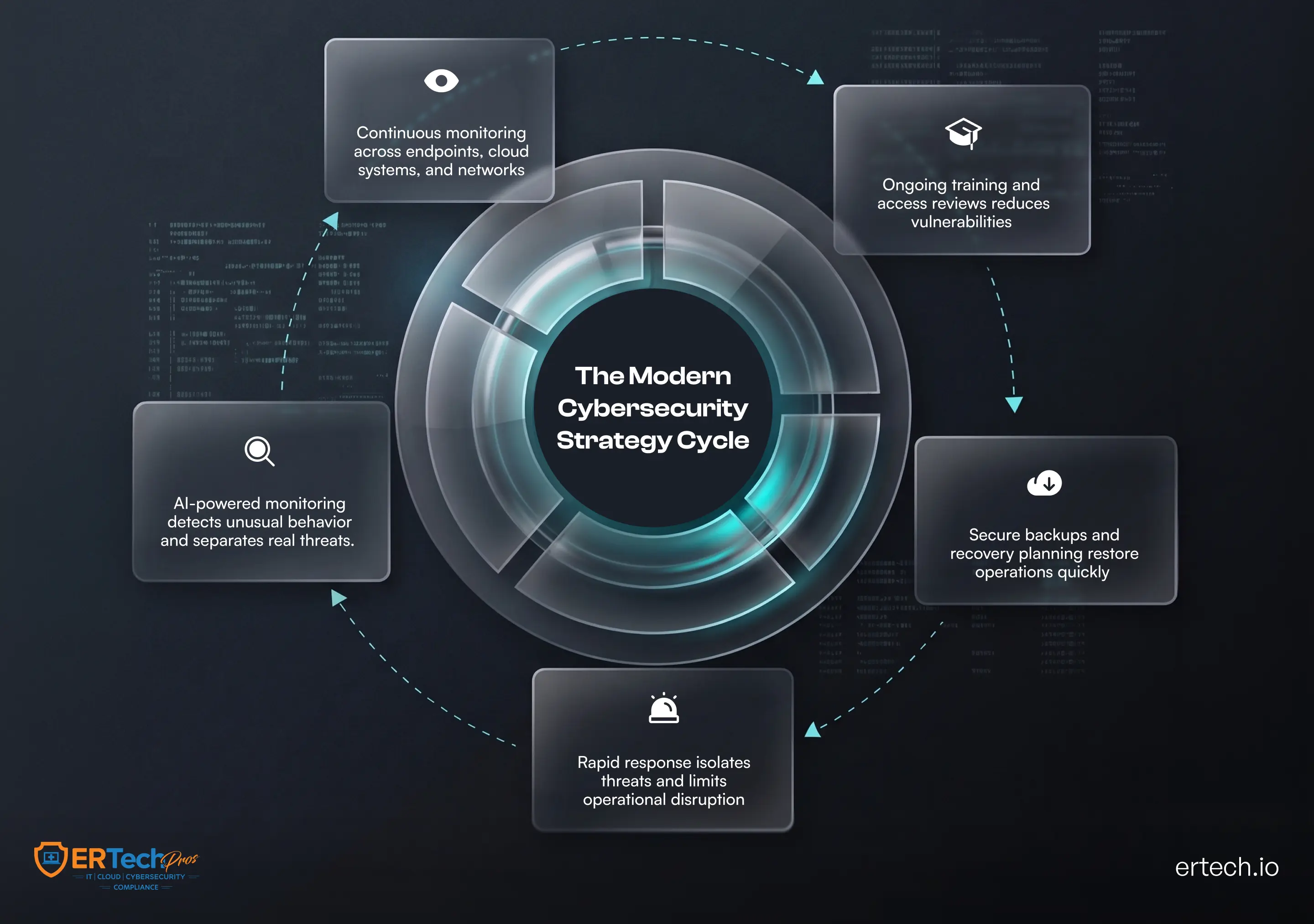
Most businesses invest in one or two stages and call it a strategy. A robust cybersecurity strategy runs all five continuously, not just after something goes wrong.
Does Your Current Program Cover Every Stage?
Building a Cybersecurity Strategy Roadmap
A cybersecurity strategy roadmap translates strategic priorities into a sequenced implementation plan with defined milestones, ownership, and timelines. It gives organizations a structured path from their current security posture to their target state, and it ensures that progress is measurable rather than assumed.
An effective cybersecurity strategy roadmap typically moves through several phases:
Assessment and Baseline: Understanding the current state of the environment, identifying existing gaps, and establishing the risk profile that will drive prioritization.
Quick Wins and Critical Fixes: Addressing the highest-risk exposures first, particularly those where the cost of exploitation far exceeds the cost of remediation. Multi-factor authentication, patch management, and endpoint protection often fall into this category.
Program Build-Out: Implementing the full layered defense architecture, formalizing incident response plans, establishing vendor risk management processes, and deploying continuous monitoring capabilities.
Ongoing Optimization: Regular testing, tabletop exercises, compliance reviews, and refinement of controls as the threat landscape and organizational environment evolve.
ER Tech Pros works with clients to build and execute cybersecurity strategy roadmaps that are realistic, sequenced appropriately for their resources, and aligned with both their business objectives and their regulatory requirements.
Enterprise Cybersecurity Strategy: What Scale Demands
For larger organizations, the complexity of an enterprise cybersecurity strategy increases significantly. Enterprise environments typically involve larger attack surfaces, more complex vendor ecosystems, stricter compliance obligations, and far greater operational consequences if a breach occurs.
An effective enterprise cybersecurity strategy must address security at multiple levels simultaneously, balancing operational continuity, regulatory requirements, user access management, and threat detection across highly interconnected environments.
Identity and Access Governance
At enterprise scale, managing who has access to what becomes a major operational challenge. Employees, vendors, and third-party platforms often require access across multiple systems, creating opportunities for excessive permissions and unmanaged accounts to accumulate over time.
Strong identity governance includes:
- Role-based access controls
- Privileged access management
- Multi-factor authentication
- Continuous access reviews
- Login anomaly monitoring
These controls reduce the risk of compromised credentials becoming large-scale operational incidents.
Supply Chain and Third-Party Risk
Enterprise organizations depend heavily on external vendors, cloud providers, software platforms, and third-party integrations. Every external connection introduces potential exposure into the environment.
A strong cybersecurity strategy must therefore extend beyond internal systems to include:
- Vendor risk assessments
- Third-party access controls
- Continuous monitoring of external integrations
- Formalized onboarding and offboarding processes
Supply chain vulnerabilities have become one of the fastest-growing cybersecurity concerns because attackers increasingly target weaker external partners as entry points into larger organizations.
Threat Intelligence and Advanced Detection
Enterprise environments are more likely to face sophisticated threats, including Advanced Persistent Threats (APTs), coordinated intrusion campaigns, and targeted ransomware operations.
Because of this, enterprise cybersecurity strategies increasingly rely on:
- Behavioral analytics
- AI-aware threat detection
- Continuous monitoring
- Threat intelligence correlation
- Security Operations Center (SOC) oversight
A strong cybersecurity risk management strategy helps enterprises prioritize these protections based on operational exposure, compliance obligations, and the potential impact of disruption across critical systems.
At ER Tech Pros, we deliver enterprise cybersecurity strategy services with 24/7 monitoring, compliance-aligned program management, advanced threat detection, and integrated security operations designed for complex business environments.
Implementing a Cybersecurity Strategy for Small Businesses
The principles behind a strong cybersecurity strategy apply at every business size, but the way small businesses implement security looks very different from enterprise environments.
Smaller organizations often face a difficult balance: cyber risks continue growing, but internal security resources, staffing, and budgets remain limited. The goal is not building enterprise-scale infrastructure overnight. It is building a practical, sustainable security foundation that reduces the most immediate risks first.
For most organizations, implementing a cybersecurity strategy for small businesses starts with strengthening the basics:
- Multi-factor authentication
- Endpoint protection
- Secure backups
- Email security
- Employee awareness training
- Patch management
- Device monitoring
These controls address many of the most common attack vectors without requiring major infrastructure investment.
A practical cybersecurity risk management strategy helps small businesses prioritize protections based on operational risk rather than trying to implement everything at once.
For many organizations, managed cybersecurity strategy services provide the most realistic path forward. Instead of building an internal security team from scratch, businesses gain access to experienced cybersecurity experts, continuous monitoring, and scalable protection at a predictable cost.
ER Tech Pros provides fully scalable cybersecurity strategy services that give small and mid-sized businesses enterprise-grade protection without the enterprise cost. Our cybersecurity services begin with a comprehensive security assessment that maps the current environment, surfaces genuine vulnerabilities, and forms the foundation for an actionable strategy tailored to the business's specific risk profile and operational reality.
The Role of Managed Cybersecurity Strategy Services
Building a strong cybersecurity strategy requires expertise across multiple areas, from compliance and risk management to threat detection and incident response. For most businesses, maintaining that level of in-house capability is difficult and expensive.
Managed cybersecurity strategy services give organizations access to experienced cybersecurity professionals, continuous monitoring, and long-term security guidance without the overhead of building an internal security team from scratch.
The most effective providers do more than respond to threats. They help businesses understand evolving risks, prioritize security investments, maintain compliance, and continuously strengthen their cybersecurity strategy as the threat landscape changes.
ER Tech Pros delivers:
- 24/7 Security Operations Center: Continuous monitoring, threat detection, and incident response with human experts who know each client's environment.
- AI-Powered Threat Detection: Machine learning integrated into monitoring and response, keeping detection capability current with AI-driven attack methods.
- Compliance-Aligned Security Programs: Full regulatory documentation and risk management frameworks for regulated industries, including HIPAA-compliant infrastructure management.
- Cybersecurity Strategy Roadmap Development: A structured, sequenced path from current posture to target state, with measurable milestones and defined ownership.
- Security Awareness Programs: Building the human layer of defense that technical controls alone cannot provide.
- Vendor Risk Assessment: Extending the security perimeter to address third-party and supply chain exposure.
A Proactive Cybersecurity Strategy Is the Future of Business Resilience
The organizations that handle cybersecurity challenges best are those that build security into daily operations rather than treating it as a separate IT function. The question is not whether to invest in cybersecurity, but whether the investment is structured to provide genuine protection.
A strong cybersecurity strategy is not just about adding more tools or checking compliance boxes. It is about reducing risk, staying prepared as threats evolve, and having the right people and processes in place when something goes wrong.
Your business took years to build. The right cybersecurity strategy protects what you've built and ensures that a single incident does not define what comes next.
At ER Tech Pros, we help organizations build that resilience every day through integrated cybersecurity solutions designed for modern business environments.
Build Your Cybersecurity Strategy With Us
Our cybersecurity services protect what you've built and ensures that a single incident does not define what comes next.
Got Questions?
We've Got Answers
Find clear answers to common questions that help guide your IT operations.
Related Content

IT Disaster Recovery Plan for Small Businesses: A Complete Guide

Cybersecurity Awareness Month: 14 Security Steps Every Business Should Take in 2026