
Network Security for Small Businesses: 7 Steps Towards Better Protection
Small businesses are among the most targeted and least protected organizations in today's threat landscape. This guide breaks down the most practical network security tips for 2026, with expert solutions from ER Tech Pros for building a defense that holds.
Small businesses have always operated with lean resources. But in 2026, that leanness comes at a price most owners are not yet prepared to pay. According to a recent study, 43% of cyberattacks target small businesses, yet only 14% are adequately prepared to defend themselves.
The assumption that cybercriminals go after big targets is one of the most dangerous myths in business today. Attacks are more frequent, more sophisticated, and more affordable to launch than ever before, and organizations with lean IT resources and no dedicated security team are exactly who threat actors are looking for.
The good news is that strong business network security does not require an enterprise budget. It requires the right priorities, the right practices, and the right partner. ER Tech Pros has spent nearly three decades helping businesses across healthcare, enterprise, and regulated industries build network security that holds up in the real world, not just on paper. This guide covers the most practical, high-impact steps small businesses can take right now.
Protect Your Network Before Attackers Find the Gaps
Why Small Business Network Security Cannot Be an Afterthought
The threat environment has shifted sharply against smaller organizations in recent years. AI has made sophisticated attacks cheaper and faster to execute. Ransomware-as-a-Service has significantly lowered the technical barrier for cybercriminals. Phishing campaigns that once required considerable manual effort are now automated, personalized, and nearly indistinguishable from legitimate communication.
For small businesses operating without dedicated security staff or mature network security solutions, the combination of high attack frequency and limited defensive capacity creates exactly the conditions attackers look for. The sections below address the most critical gaps in a practical, direct way.
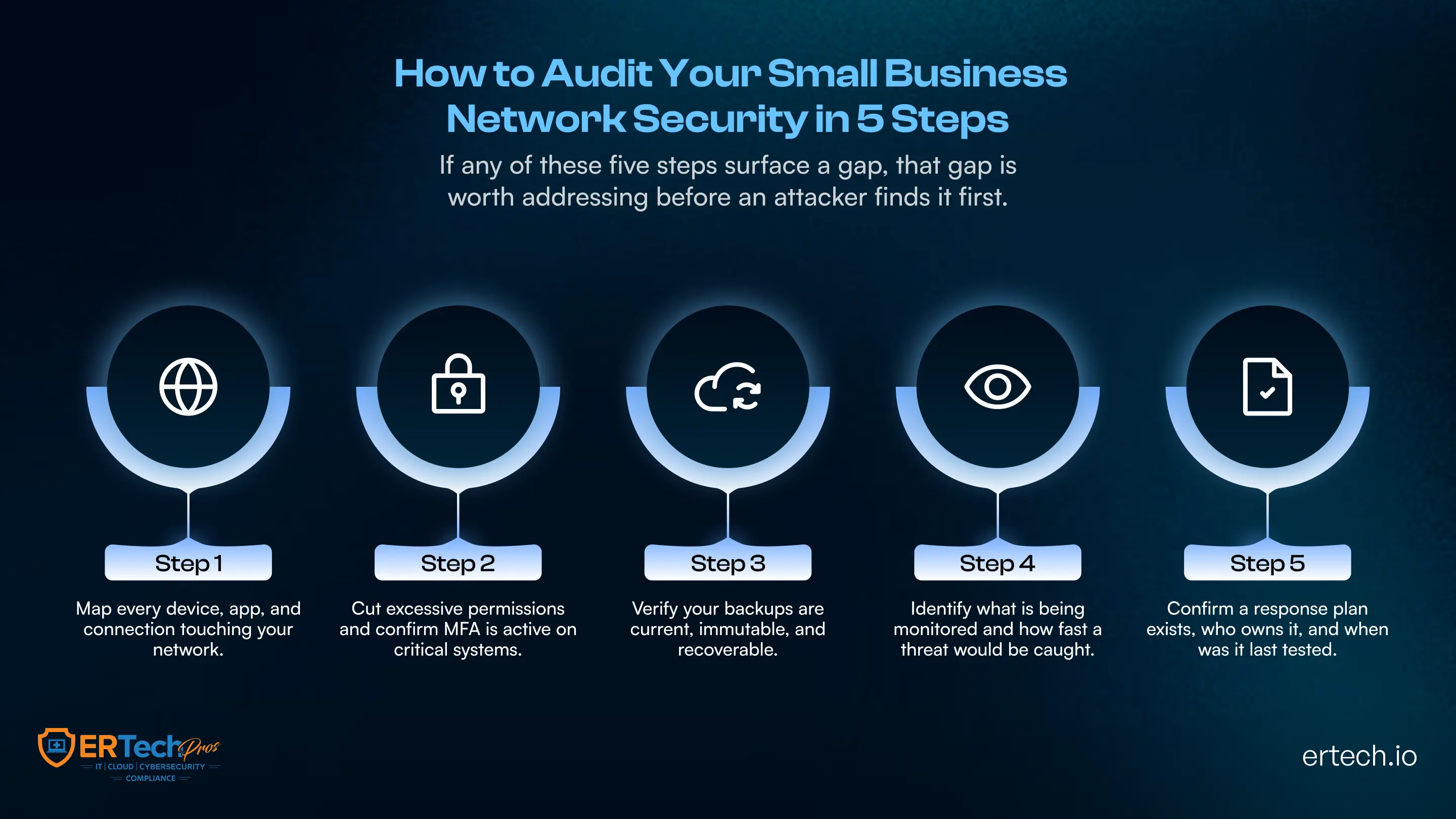
1. Start With a Firewall That Is Configured, Not Just Installed
A network firewall is the first and most fundamental layer of business network security. But a firewall installed once and never revisited is not providing the protection most businesses assume it does.
Common Firewall Gaps in Small Business Environments
Default configurations, outdated rule sets, and absent logging are common across small business environments, and each one is a gap that can be exploited. Many businesses assume that having a firewall in place is sufficient, without realizing that the real protection comes from how it is managed over time.
What Effective Network Firewall Security Looks Like
Effective network firewall security means rules that are reviewed and updated as your environment changes, inbound and outbound traffic filtering rather than inbound alone, application-layer inspection that goes beyond basic port blocking, and logging that makes anomalies visible before they escalate into incidents. If your firewall has not been audited in the past 12 months, treat it as an open door until confirmed otherwise.
2. Segment Your Network to Limit What an Attacker Can Reach
Network segmentation is one of the most effective and most underutilized networking security solutions available to small businesses. The concept is straightforward: divide your network so that access to one area does not automatically mean access to everything else.
How Segmentation Works in Practice
In practice, this means separating guest Wi-Fi from internal systems, isolating payment or point-of-sale environments from general business traffic, and keeping sensitive data on its own segment with access controlled to the roles that require it.
Why It Matters for Ransomware Attack Prevention
Lateral movement, in which an attacker pivots from an initial entry point to higher-value targets, is a defining feature of modern ransomware campaigns and advanced persistent threats. Segmentation does not prevent the initial breach, but it can contain a manageable incident before it becomes catastrophic.
3. Take Cloud Network Security as Seriously as On-Premise Security
Most small businesses today operate across a mix of cloud applications, SaaS platforms, file storage services, and collaboration tools. Each of those connections extends your attack surface in ways that on-premise security controls alone cannot cover.
Identity, Access, and Authentication
Cloud network security for small businesses starts with identity and access management, controlling who can access what, from where, and under what conditions. Multi-factor authentication across every cloud application is non-negotiable, because credential theft is one of the most common entry points into cloud environments, and MFA remains one of the highest-return defenses available at any budget level.
Monitoring What Most Businesses Miss
API connections and third-party integrations often sit entirely outside the visibility of traditional security tools. Without active monitoring of these connections, small businesses are left with blind spots in environments they rely on daily. Data classification and encryption ensure that even if an account is compromised, the exposure is contained.
4. Build a Layered Ransomware Attack Prevention Strategy
Ransomware remains one of the most operationally destructive network security threats small businesses face. In 2026, the tactics have evolved well beyond simple file encryption. Modern ransomware operations exfiltrate data before encrypting it, then use the threat of public exposure or regulatory notification as additional leverage, compounding the damage far beyond the initial incident.
The Defenses That Stop Ransomware
Effective ransomware attack prevention requires multiple controls working together because no single tool stops a determined campaign:
Endpoint protection with behavioral detection identifies suspicious execution patterns before known malware signatures are even available, stopping threats that traditional antivirus would miss entirely.
Email security with AI-powered filtering addresses phishing at the point of delivery, which remains the most common mechanism by which ransomware enters small-business environments.
Immutable, regularly tested backups ensure recovery takes hours rather than weeks. Backups that have never been tested are not a recovery plan; they are an assumption.
Defined patch management schedules close the vulnerabilities that ransomware operators routinely scan for and exploit, reducing the window of exposure between when a vulnerability is discovered and when it is remediated.
The Role of Incident Response Planning
Having a documented incident response plan in place before an attack occurs, with clear roles, communication protocols, and recovery procedures, dramatically reduces the damage when an incident occurs. The businesses that recover fastest are not the ones that figure it out as they go; they are the ones that practiced before they needed to.
5. Treat Security Awareness Training as an Ongoing Practice
The most sophisticated technical controls available cannot fully compensate for an employee who does not recognize a phishing email. Human error remains one of the most consistent contributing factors to cybersecurity breaches of all types, and AI has made the social engineering tactics that exploit it significantly more convincing.
What Effective Training Looks Like
Effective cybersecurity strategies for businesses treat security awareness as a continuous operational discipline, not an annual checkbox. That means regular simulated phishing campaigns that reflect current attack techniques, training updates as specific threat tactics evolve, and clear reporting channels so employees know exactly what to do when something looks suspicious.
Building the Human Layer of Defense
The goal is not to turn every employee into a security expert. It is to make the workforce a meaningful obstacle rather than an easy entry point. Leadership modeling of expected security behaviors matters here as much as formal training; culture shapes behavior in ways that mandatory modules alone cannot.
6. Extend Network Security Coverage to Every Remote Endpoint
Remote and hybrid work has permanently changed what small business network security must cover. Employees accessing company systems from home networks, personal devices, and public connections are endpoints that often fall outside the security controls that protect the core environment.
The Minimum Baseline for Remote Work Security
Minimum viable endpoint security for remote work in 2026 includes endpoint detection and response tools deployed across all company-managed devices, mobile device management for any device accessing business applications or data, and secure remote connectivity via VPN or Zero Trust Network Access to avoid exposing internal systems directly to the internet.
Why Unmanaged Devices Are an Active Risk
Unmonitored and unmanaged remote devices are not just a compliance concern. They are active blind spots in your network security posture. Clear policies governing which devices can access which systems, and under what conditions, are as important as the technical controls enforcing them.
7. Move From Periodic Reviews to Continuous Network Monitoring
Periodic security reviews tell you what your posture looked like at a point in time. Continuous monitoring tells you what is happening right now. For small businesses facing a threat environment as fast as today's, the difference between the two approaches is the difference between catching an incident early and discovering a breach long after the damage is done.
What Continuous Monitoring Delivers
Continuous monitoring provides real-time visibility into traffic anomalies and unusual access patterns, faster detection and containment before incidents escalate, audit trails that support both regulatory compliance and post-incident investigation, and ongoing vulnerability identification rather than point-in-time snapshots.
How Managed Network Security Services Fill the Gap
For small businesses without in-house security operations capacity, managed network security services make continuous monitoring operationally and financially realistic. Rather than building and staffing a security operations function internally, businesses gain access to experienced cybersecurity professionals monitoring their environment around the clock, at a predictable cost that reflects the scale of their actual needs.
8. Manage Vendor and Third-Party Access as Carefully as Your Own
Every vendor, contractor, or platform with access to your systems is a potential entry point into your environment. A breach at a third party can expose your data and your customers' data even when your own network security solutions are functioning correctly. Supply chain risk has become one of the fastest-growing exposure categories in business network security, and small businesses with fewer resources to audit vendor relationships face disproportionate exposure.
Practical Steps for Third-Party Risk Management
Start by inventorying every external connection to your environment, including integrations that individual teams may have set up without formal IT oversight. Apply least-privilege access so vendors and contractors have only what they need for the specific engagement. Remove access promptly when engagements end. Review vendor security practices before granting access and revisit those reviews periodically, because access that was appropriate six months ago may no longer be warranted today.
How ER Tech Pros Delivers Network Security Built for Small Businesses
Understanding what strong small business network security looks like and implementing it consistently are two very different challenges, particularly for organizations without dedicated security staff. ER Tech Pros delivers integrated network security services designed around how small and mid-sized businesses operate, covering every layer of the environment rather than addressing each piece in isolation.
24/7 Security Operations Center: Cybersecurity professionals monitoring client environments continuously, detecting threats and responding to incidents around the clock, not just during business hours.
Managed Network Security Services: Comprehensive management of your network security environment, including firewall oversight, endpoint protection, patch management, and continuous vulnerability assessment, without requiring specialized in-house staff across every discipline.
AI-Aware Threat Detection: Machine learning integrated into monitoring and response, keeping detection capability in step with the AI-driven attack methods reshaping the threat landscape for small businesses.
Cloud Network Security Management: Security coverage extending across cloud environments, SaaS applications, and third-party integrations, providing the unified visibility that on-premise tools alone cannot deliver.
Ransomware Attack Prevention and Incident Response: Layered defenses built to prevent, detect, and contain ransomware incidents, combined with a tested response capability that minimizes recovery time and operational disruption.
Cybersecurity Awareness Programs: Ongoing staff training that builds the human layer of defense, covering the phishing techniques, social engineering tactics, and AI-generated threats most relevant to your organization.
Compliance-Aligned Security Programs: For businesses in regulated industries, security programs aligned to specific regulatory frameworks, ensuring that compliance documentation and genuine operational protection advance together.
Stop Leaving Your Network to Chance
The gap between businesses building resilience and those still treating network security as a periodic IT task is widening every year. Threat actors are not waiting for small businesses to catch up, and the cost of falling behind, financially, operationally, and reputationally, is higher in 2026 than it has ever been.
ER Tech Pros understands that small businesses cannot afford to gamble on their network security. That is why we deliver managed network security services that are proactive, integrated, and built around how small and mid-sized businesses operate.
The businesses that navigate this environment successfully are not necessarily the ones with the largest budgets. They are the ones who have the right foundations in place and the right partner consistently supporting them. ER Tech Pros is that partner.
Is Your Network Security Strategy Keeping Pace With Today's Threats?
ER Tech Pros helps businesses build practical, scalable security programs designed for today's evolving threat landscape.
Got Questions?
We've Got Answers
Find clear answers to common questions that help guide your IT operations.
Related Content
How to Build an Effective Ransomware Response Plan

How Does Ransomware Work? A Step-by-Step Guide for Businesses